
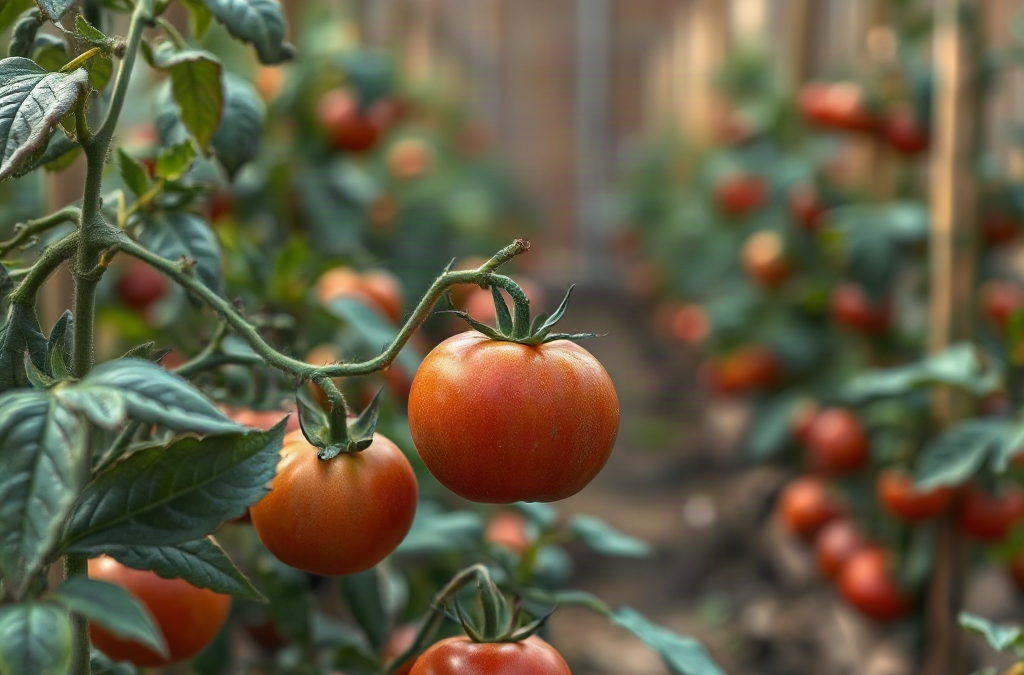
Space most staked or caged tomato plants 24 to 36 inches apart within rows, with 36 to 48 inches between rows, to preserve airflow as the canopy fills out. Compact determinate varieties may fit near the lower end, while vigorous indeterminate plants often need the upper end or more unless they are pruned and trained vertically. Wider spacing reduces leaf overlap, allows morning dew and rain to dry sooner, and makes harvesting and disease inspection easier. Measure from stem to stem, account for the mature width of cages, and avoid narrowing walking aisles with sprawling side shoots.
What you’ll learn
This guide covers the following practical points:
- How Far Apart Should Tomatoes Be Within a Row? — In-row distance should be based on the plant's expected mature canopy rather than the size of the transplant on planting day.
- How Much Space Should Be Left Between Rows? — Row spacing must keep an open corridor after the plants and supports reach full size.
- How Variety, Support, and Pruning Change Spacing — Growth habit determines whether close spacing remains manageable or becomes a wall of foliage.
- How to Build and Maintain an Airy Tomato Row — An airy row is established with accurate layout and preserved through irrigation, support, and timely canopy checks.
How Far Apart Should Tomatoes Be Within a Row?
In-row distance should be based on the plant’s expected mature canopy rather than the size of the transplant on planting day. A young tomato may occupy only a few inches, but its side shoots and compound leaves can eventually reach into neighboring plants. Once adjacent canopies interlock, still pockets form around the lower and interior foliage. Rain, irrigation splash, and dew then remain on leaves longer than they would in a more open row.
For a practical starting point, place compact, supported determinate tomatoes about 24 inches apart. Give larger determinate plants and moderately managed indeterminate plants roughly 30 to 36 inches. Vigorous indeterminate varieties allowed to branch freely may require 36 to 48 inches. These are working ranges rather than universal rules. Humid conditions, partial shade, fertile soil, and frequent rainfall favor wider placement because each condition can produce denser foliage or slower drying.
| Planting Situation | Typical In-Row Spacing | Typical Row Spacing | Main Consideration |
|---|---|---|---|
| Compact determinate plants with sturdy cages | About 24 inches | 36 to 42 inches | Confirm that mature cages will not touch |
| Large determinate plants | 30 to 36 inches | 42 to 48 inches | Allow room for a broad, bushy canopy |
| Indeterminate plants trained to one or two leaders | 24 to 30 inches | 36 to 48 inches | Requires consistent tying and pruning |
| Indeterminate plants with limited pruning | 36 to 48 inches | 48 inches or more | Accommodate side shoots and wide supports |
Measure from the center of one main stem to the center of the next. Do not measure from the edge of the planting hole or from the current leaves. If cages are 24 inches wide, plants placed 24 inches apart will leave the cages touching. That arrangement may be workable for small varieties in a dry, sunny site, but it provides little margin when branches push through the wire.
A common mistake is treating closer placement as a reliable way to gain more fruit from a short row. It does increase the number of roots competing in that area, but the crowded foliage can make watering, tying, harvesting, and inspecting leaves harder. If space is limited, fewer plants with usable access may perform more predictably than an extra plant squeezed into the row. Mark the mature spacing before digging, then reduce the plant count rather than compressing the final interval.
How Much Space Should Be Left Between Rows?
Row spacing must keep an open corridor after the plants and supports reach full size. A 36-inch path can disappear when cages lean outward or unpruned branches extend a foot into the aisle. For many home plots, 36 to 48 inches between row centerlines is a reasonable starting range, while sprawling or minimally pruned tomatoes may need 48 inches or more.
The aisle contributes to airflow differently from the gap between neighboring stems. In-row spacing opens the canopy along its length; the aisle exposes the sides of the plants to moving air and sunlight. A usable aisle also lets a gardener remove damaged foliage without brushing against every wet plant. Contact with wet leaves does not create disease by itself, but moving repeatedly through dense, damp growth can transfer contaminated soil or plant material around the planting.
Orientation matters when the site allows a choice. Rows running north to south often distribute sunlight more evenly between their two sides as the sun crosses the sky. East-to-west rows may cast a longer shadow onto the row immediately north, especially when indeterminate tomatoes are trained on tall supports. Local obstacles can matter more than compass direction, however. A fence, shed, hedge, or solid windbreak may create a sheltered pocket where damp foliage dries slowly. Place the row where ordinary breezes can pass through without exposing unsupported plants to damaging gusts.
Raised beds require a different calculation. Two rows in a four-foot-wide bed may look efficient, but their canopies can merge over the center even when the stems are separated. Staggering the plants in an offset pattern provides more diagonal room than placing them directly opposite each other. Another option is one row down the bed’s center, trained onto a tall trellis. The single-row plan sacrifices plant count but improves access from both sides and is often easier to manage in a humid location.
Do not calculate row distance from bare soil alone. Include the diameter of cages, the angle of stakes, trellis anchors, and enough standing room for harvesting. A good field check is whether you can walk the aisle without turning sideways or pushing healthy leaves away. If the passage closes by early summer, the original row spacing or ongoing canopy control is insufficient for that setup.
How Variety, Support, and Pruning Change Spacing
Growth habit determines whether close spacing remains manageable or becomes a wall of foliage. Determinate tomatoes produce a more limited framework and set much of their crop over a concentrated period, although individual cultivars vary considerably in size. Indeterminate tomatoes continue extending stems and producing side shoots while conditions remain favorable. A spacing label that ignores this distinction can be misleading.
Support style changes the plant’s footprint. A strong vertical trellis can keep trained indeterminate stems narrow, allowing them to stand closer than the same varieties grown in broad cages. That advantage depends on regular attention. New shoots must be selected, tied, or pruned before they weave through neighboring plants. If a gardener expects to be away for several weeks during rapid summer growth, wider spacing provides useful tolerance for missed maintenance.
Cages generally preserve more branches and require less selective pruning, but their diameter sets a firm minimum. Place empty cages at the planned marks before transplanting. If the cage rims overlap or leave no hand space between them, the plants will be difficult to inspect once filled. Short stakes may hold the main stem upright while lateral growth falls into the aisle, so staking alone does not guarantee a narrow canopy.
Pruning can improve internal air movement, but aggressive leaf removal is not a substitute for adequate distance. Leaves power growth and shade fruit from intense sun. A practical approach is to remove shoots according to the chosen training system, clip leaves that rest on soil, and remove clearly damaged or heavily spotted foliage with clean cuts. Avoid stripping the plant merely to create a sparse appearance. The useful target is a supported canopy with separated stems and reachable fruit, not a bare vine.
Consider two gardeners using 30-inch spacing. One grows indeterminate plants on a trellis, retains two main leaders, ties them weekly, and directs irrigation to the soil. The other uses undersized cages and lets every side shoot develop. Their measurements match, but their airflow will not. Spacing works as part of a management system; variety choice, support width, pruning frequency, sun exposure, and watering method determine whether the original gaps remain open.
Read the seed packet or nursery label for the cultivar’s stated spread, then compare that figure with the planned support. When the information is vague, choose the wider interval. Correcting excess room is easy with mulch or a low-growing companion placed outside the tomato canopy. Correcting severe crowding after roots and trellises are established is much harder.
How to Build and Maintain an Airy Tomato Row
An airy row is established with accurate layout and preserved through irrigation, support, and timely canopy checks. Before planting, place stakes or empty cages at their intended centers. View the arrangement from both ends of the bed and account for branches extending beyond each support. This simple dry layout reveals crowding that is easy to miss when measuring small transplants.
Use a short setup checklist:
- Estimate mature width: identify whether each cultivar is compact determinate, large determinate, or indeterminate.
- Set support first: include cage diameter, trellis posts, and anchors in the layout.
- Mark stem centers: use measured intervals rather than visual guesses.
- Protect the aisle: reserve enough width for harvesting without contacting both rows.
- Plan soil-level watering: position drip lines or soaker hoses before the canopy closes.
Water placement influences how well spacing performs. Applying water near the soil reduces routine wetting of the foliage, while mulch limits soil splash onto lower leaves. If overhead watering is the only practical option, applying it early in the day generally gives foliage more time to dry than watering late in the evening. Wider spacing cannot compensate for constantly wet leaves, poor drainage, or a shaded site with little air movement.
Inspect the row from ground level every week during rapid growth. Look for leaf layers pressed together, branches lying across the path, foliage touching the soil, and interior leaves that remain damp long after the outer canopy dries. Tie wandering stems back to their support and remove appropriate side shoots before they become thick. Handle plants when foliage is dry when practical, and clean cutting tools after working with suspiciously spotted or declining material.
Signs that the layout is working include visible gaps between supported canopies, accessible lower stems, and leaves that dry reasonably soon after dew or irrigation. Warning signs include a dark, compressed interior, fruit that cannot be reached without breaking stems, and an aisle that vanishes behind side shoots. Leaf spots can occur even with generous spacing because pathogens, weather, and plant susceptibility still matter. Airflow is a risk-management measure, not a guarantee against tomato disease.
If the row is already crowded, avoid removing a large share of healthy foliage at once. First secure fallen branches, clear leaves touching soil, restore the walking path, and redirect irrigation below the canopy. Selective thinning can follow according to plant vigor and training style. When plants are irreversibly intertwined, record the support width and mature spread, then increase next season’s spacing rather than repeating the original layout.
Frequently Asked Questions
Can tomatoes be planted 12 inches apart?
Twelve-inch spacing is usually too tight for ordinary caged or bush-grown tomatoes. It may be used in an intensively managed vertical system with suitable cultivars, strict pruning, strong support, and close monitoring, but it leaves little tolerance for missed maintenance.
Is 24 inches enough between tomato plants?
Twenty-four inches can work for compact determinate plants or carefully trained indeterminate vines. Choose a wider interval for broad cages, vigorous varieties, humid sites, limited pruning, or beds receiving less than ideal sun.
Should determinate and indeterminate tomatoes use the same spacing?
No. Determinate plants often fit closer because their growth is more limited, while indeterminate vines continue extending and branching. The cultivar's mature spread and the support system should settle the final distance.
Does wider tomato spacing prevent fungal disease?
Wider spacing can encourage faster drying and easier inspection, but it does not prevent every disease. Weather, infected plant material, soil splash, cultivar susceptibility, irrigation practices, and sanitation also influence disease pressure.
Can two tomato rows fit in a four-foot-wide raised bed?
Two rows may fit if compact plants are staggered and kept within their supports, but large tomatoes can merge over the bed's center. One centered, vertically trained row often provides better access and canopy separation.
Conclusion
Plan tomato rows around mature foliage and support dimensions, not transplant size. Start by identifying each variety’s growth habit, placing the cages or trellis, and marking stem centers before digging. Preserve a functional aisle as carefully as the distance between plants; both gaps contribute to drying, inspection, tying, and harvest access.
Choose wider intervals when humidity is high, sunlight is limited, cages are broad, or pruning will be occasional. Closer planting is most workable with narrow vertical training and dependable maintenance. During the season, direct water toward the soil, secure wandering stems, clear foliage from the ground, and watch whether interior leaves stay damp. If canopies repeatedly merge despite those measures, record the actual mature width and adjust next year’s layout rather than relying on heavier pruning alone.


