
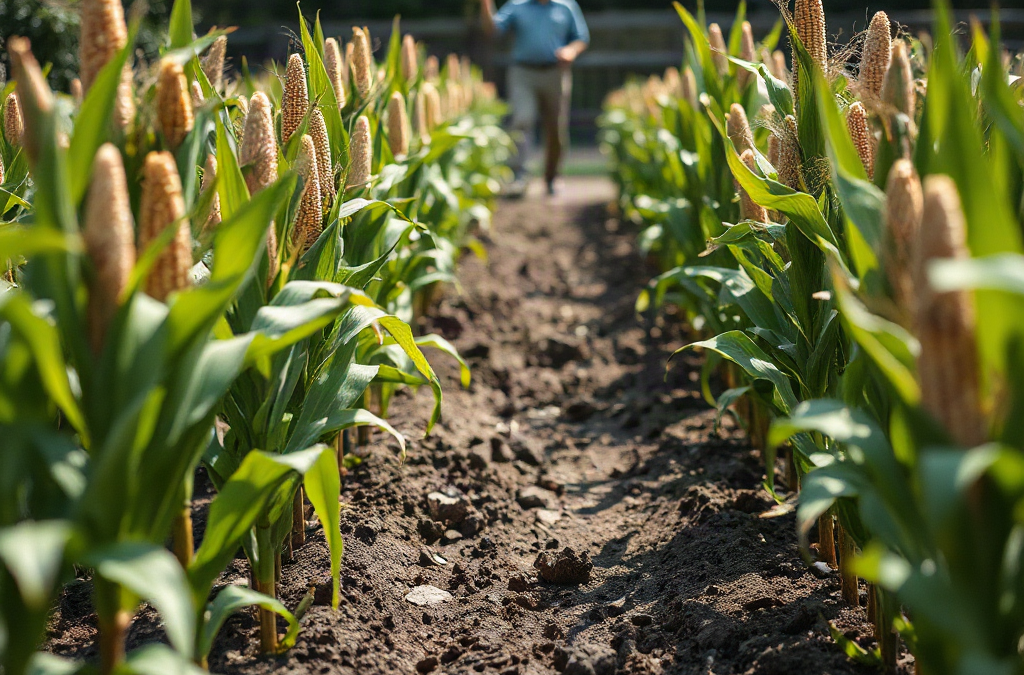
Space corn plants 8–12 inches apart, with 24–36 inches between rows, to limit crowding while preserving the close block needed for wind pollination. In compact garden beds, use a grid or several short rows rather than one long row, and favor the wider end of the range for tall, vigorous varieties. Adequate spacing allows sunlight to reach lower leaves, reduces competition for water and nitrogen, and leaves room for air movement. Thin seedlings after emergence instead of leaving extras in each station, because crowded stalks commonly produce smaller ears, weak stems, and uneven kernel development.
What you’ll learn
This guide covers the following practical points:
- How Far Apart Should Corn Be Planted? — A practical starting layout places individual corn plants 8–12 inches apart and separates conventional rows by 24–36 inches.
- Why Does Block Planting Improve Pollination? — Corn performs better in several adjacent short rows or a compact block because it is pollinated primarily by wind.
- How Should Spacing Change for the Bed and Variety? — The best final spacing reflects the variety’s mature size, the bed’s usable root volume, sunlight, soil fertility, and irrigation reliability.
- How to Recognize and Correct Corn Crowding — Crowding first appears as uneven competition rather than a single unmistakable symptom.
How Far Apart Should Corn Be Planted?
A practical starting layout places individual corn plants 8–12 inches apart and separates conventional rows by 24–36 inches. Those ranges leave enough root and leaf space for most home-garden sweet corn without spreading the plants so widely that wind-borne pollen has difficulty reaching neighboring silks. The seed packet remains the best place to check for cultivar-specific instructions, particularly when planting unusually short, tall, early, or late varieties.
Spacing must be measured between the plants that remain after thinning, not merely between seeds at sowing. Gardeners often sow seeds 2–3 inches apart as insurance against poor germination and then leave every successful seedling. That turns an appropriate sowing pattern into a crowded stand. Once seedlings are several inches tall and establishment is clear, retain the strongest plant at each intended position. Cut unwanted seedlings at soil level if pulling them would disturb the roots of the keeper.
Raised beds allow a more compact arrangement because plants can be reached from the sides and do not need wide walking aisles between every row. A bed might hold corn on a 10- to 12-inch grid, provided the soil is fertile, moisture is kept reasonably even, and the variety is not exceptionally vigorous. The tighter arrangement uses bed area efficiently, but it also increases demand for water and nutrients. A 12-inch grid is more forgiving than an 8-inch grid during hot weather or in shallow soil.
| Planting situation | Plant-to-plant spacing | Row or grid spacing | Practical consideration |
|---|---|---|---|
| Conventional garden rows | 8–12 inches | 24–36 inches | Allows access and good light penetration |
| Raised-bed block | 10–12 inches | 10–12 inches each way | Requires steady moisture and fertile soil |
| Tall or vigorous variety | 12 inches or more | 30–36 inches | More room reduces shading and lodging pressure |
More plants do not automatically mean more usable corn. Packing seedlings closely may increase the number of stalks, yet each stalk receives a smaller share of the available light, moisture, nitrogen, and root volume. The better target is a stand of evenly spaced, sturdy plants capable of filling ears. Mark the bed before sowing, count the final planting positions, and thin decisively rather than treating every germinated seed as a plant that must be saved.
Why Does Block Planting Improve Pollination?
Corn performs better in several adjacent short rows or a compact block because it is pollinated primarily by wind. Pollen drops from the tassels near the top of each stalk and must land on the silks emerging from developing ears. A narrow, isolated row gives pollen fewer chances to cross neighboring plants, especially when the prevailing wind carries it away from the row.
Each silk corresponds to a potential kernel. When a silk does not receive viable pollen, the associated kernel may not develop, leaving blank areas on the cob. Spacing therefore has two jobs that can appear to conflict: plants need enough room to avoid competition, but the stand must remain compact enough for pollen to move among stalks. A block resolves that conflict better than a long line along a fence.
For example, sixteen plants arranged as four rows of four generally create a more useful pollen footprint than the same sixteen plants arranged in one row. In a narrow raised bed, two parallel rows may be the only option, but three or four short rows are preferable when the bed dimensions permit them. A square or nearly square planting also exposes more silks to pollen arriving from different directions.
Hand pollination can supplement a very small planting. Once tassels are shedding pollen and silks are visible, gardeners can gently shake stalks during dry, calm conditions or collect pollen and transfer it to fresh silks. This is a backup measure rather than permission to overcrowd the bed. Plants squeezed together may pollinate yet still lack the resources to fill their ears properly.
Separate varieties also require attention. Different sweet corn types can release pollen at the same time, and cross-pollination may affect eating quality in the current ears. Physical distance is difficult to achieve in a small yard, so staggering planting dates to separate tasseling periods may be more practical. That timing issue is distinct from plant spacing: increasing gaps between plants within one bed does not reliably isolate varieties. Prioritize a compact block for each planting, then manage variety separation through timing or meaningful distance where space allows.
How Should Spacing Change for the Bed and Variety?
The best final spacing reflects the variety’s mature size, the bed’s usable root volume, sunlight, soil fertility, and irrigation reliability. A generic number cannot compensate for a shaded bed or dry, compacted soil. When conditions restrict growth, reducing the number of plants usually produces better results than forcing a full seed-packet population into the available area.
Tall, late-season corn casts more shade and develops a larger canopy than many compact or early cultivars. Give vigorous plants at least the wider end of the recommended range. Closely planted tall stalks can become thin as they compete for light, making them more vulnerable to leaning during wind or heavy rain. Shorter spacing may work for a cultivar specifically described as compact, but the mature dimensions and packet directions should drive that choice rather than assumptions based only on days to maturity.
Bed width determines the useful pattern. A four-foot-wide bed can often accommodate four rows around 12 inches apart, with plants offset where helpful to spread stems and roots. Leave a reasonable setback from the bed edge so outer plants do not dry faster or lean into a path. A two-foot-wide strip may hold only two rows; extending the planting along the strip does not create the same pollination density as a broader block, so supplemental hand pollination may be worthwhile.
Soil depth matters as much as surface area. Corn has an extensive root system and is a demanding feeder. A shallow bed over hard subsoil provides less buffering against heat and missed watering than deep, workable ground. Under those constraints, wider spacing reduces simultaneous demand. Adding extra fertilizer while preserving an overly dense layout is not a complete solution: nutrients cannot replace root room, light, oxygen, or water.
Use this sequence before planting:
- Measure usable bed dimensions. Exclude edge space and any area shaded for much of the day.
- Read the cultivar directions. Note mature height and suggested in-row spacing.
- Draw a block. Fit several short rows or a grid rather than one continuous line.
- Count final plants. Base seed quantities on the number to retain after thinning.
- Choose the conservative spacing. Widen gaps when soil is shallow, watering is irregular, or the cultivar is tall.
A common mistake is copying dense field-corn geometry into a hand-watered garden bed. Agricultural row arrangements reflect specific machinery, hybrids, fertility programs, and plant populations. Home beds have different access needs and often less uniform water delivery. A slightly lower population with reachable, evenly lit stalks is usually easier to manage and diagnose.
How to Recognize and Correct Corn Crowding
Crowding first appears as uneven competition rather than a single unmistakable symptom. Look for thin stalks, strong differences in plant height, lower leaves that remain shaded, rapid wilting between waterings, or neighboring plants leaning away from one another. Later signs can include small ears, ears that do not fill well, and weak stalks that lodge. Some of these symptoms also arise from low fertility, drought, root damage, or poor pollination, so spacing should be assessed alongside soil and watering conditions.
Measure actual stem-to-stem gaps rather than judging the canopy by sight. Corn leaves naturally overlap, and healthy plants may look full without being overcrowded. If stems are consistently much closer than the planned spacing because several seeds emerged together, thinning is the direct correction. Do it early, before roots become heavily intertwined and before the strongest plants lose weeks of growth to competition.
When corn is still young, keep the most upright, vigorous seedling at each position and cut the others at ground level. Avoid yanking a large unwanted plant immediately beside the keeper; corn roots can overlap, and pulling may loosen both plants. Do not transplant thinned seedlings unless they are very small and can be moved with minimal root disturbance. Direct-sown corn generally establishes more predictably than older transplants with damaged roots.
Once stalks are knee-high or larger, aggressive thinning becomes a tradeoff. Removing badly suppressed plants can free resources, but cutting established stalks also creates gaps and reduces the pollen-producing population. At that stage, focus on even irrigation, weed control, and appropriate feeding based on soil conditions, then note the layout change needed next season. Removing healthy mature plants solely because leaves touch is rarely justified.
Check whether the spacing plan is working at three points. Early in growth, seedlings should be relatively uniform rather than divided into dominant and stunted groups. Before tasseling, stalks should remain sturdy and the bed should not dry immediately after watering. During ear formation, silks should receive pollen and ears should begin filling without widespread lodging. Patchy kernels mainly indicate incomplete pollination, whereas uniformly small ears and weak growth more strongly suggest resource limitations or broader plant stress.
Do not mistake close planting for protection against wind. A dense stand may support neighboring leaves, but slender, light-starved stalks can still fall as a group. Proper spacing, deep watering that encourages rooting, and avoiding excessive late nitrogen are more useful than preserving extra stalks. If a bed repeatedly produces weak plants, reduce the population next year before adding more inputs.
Frequently Asked Questions
Can corn be planted 6 inches apart?
Six-inch spacing is usually too tight for a typical home bed unless the cultivar and production method specifically support a dense stand. Use 8–12 inches as a more forgiving range, with wider spacing for tall corn or unreliable irrigation.
How many rows of corn are needed for pollination?
Plant at least three or four short adjacent rows when space allows. A compact block exposes silks to more wind-carried pollen than one long row, although small plantings may still benefit from hand pollination.
Can corn grow in a four-foot-wide raised bed?
Yes. A four-foot bed can often hold four rows spaced about 12 inches apart, subject to the variety’s directions, bed depth, fertility, and water supply. Keep plants slightly back from dry bed edges.
Should more than one corn seed be left in each hole?
No. Multiple seeds may be sown for germination insurance, but the cluster should normally be thinned to one strong plant. Cut extras at soil level to avoid disturbing the selected seedling’s roots.
Why are corn ears poorly filled despite adequate spacing?
Missing kernels often point to incomplete pollination rather than crowding alone. A small or single-row planting, mismatched tassel and silk timing, extreme weather during pollination, or insufficient pollen movement may be responsible.
Conclusion
Successful corn layout balances root and canopy room with the compact planting needed for dependable pollen movement. Start with the cultivar’s directions, then fit the plants into several short rows or a grid instead of stretching them along one edge of the yard. Favor wider gaps when the variety is tall, the soil is shallow, or watering may be inconsistent.
Mark final positions before sowing and thin clusters while seedlings are young. During the season, judge the layout by stem strength, growth uniformity, soil moisture, and ear development—not by whether leaves overlap. If plants become thin, uneven, or difficult to keep watered, record the actual spacing and lower next year’s plant count. A modest number of sturdy, accessible stalks is more valuable than a crowded bed full of plants that cannot develop full ears.


